Stas, communications specialist and photographer
Стас: Об’єктив, що фіксує передчуття
Stas was born in Odesa, where he attended a school in which Russian was the primary language of instruction. Ukrainian was present, but less central. For several years before 2022, he had been convinced that Russia would eventually attack Ukraine. When the invasion began, he was not surprised, only confronted with the reality he had long anticipated.
He recalls earlier shifts in the city’s atmosphere. Before 2014, there were informal gatherings where some participants would say “Slava Rossii” instead of “Slava Ukraini”-a detail that, in retrospect, reflects tensions that were already present. By 2021, Stas was working remotely in marketing for a foreign company, which allowed him a degree of stability when the war began. Alongside this, he was active in civil society in Odesa, engaged in political activism and initiatives to preserve the city’s architecture and coastline.
In late 2021, he considered buying protective gear but ultimately decided against it. On the evening of 23 February, he and his wife watched Don’t Look Up. His attention, however, was elsewhere-scrolling through the news, waiting for escalation. In the early hours of the next morning, explosions woke him. He immediately understood what was happening. Waking his wife was more difficult; she struggled at first to believe that the war had begun.
Within days, he arranged for his wife and some family members to evacuate to Lviv. He wanted them to be safe, to remove at least one layer of uncertainty. He briefly considered mobilising but hesitated. At recruitment points, he sensed that not everyone present was necessarily aligned, and he was aware that pro-Ukrainian activists could become targets in the event of Odesa’s occupation. When the risk of an attack on Odesa seemed imminent, he left for Lviv himself, staying for about a month before returning.
Back in Odesa, Stas became involved as an interpreter for foreign volunteers joining Ukraine’s International Legion. For about a year, he worked alongside them during training, translating and supporting communication. He had hoped to join them in service, but this did not materialise. Instead, his trajectory shifted again.
In 2023, he joined the United Nations, working in communications. His role took him across Ukraine, including regular trips to front-line areas, documenting humanitarian efforts. He often found himself questioning the value of his contribution-whether documenting and communicating was enough in a time of war. Some of his photographs were later used by Samantha Power, then representing the United States at the United Nations, a moment that underscored the reach of his work.
The changes in Odesa, he says, are sometimes difficult to grasp from within. Yet certain details stand out. In the past summer, the city felt more populated again, with trains fully booked-something that had not been the case since the pandemic and the early war years. At the same time, traces of destruction remain visible. Small shards of glass from shattered windows can lie on the ground for weeks or months, quietly marking the sites of explosions.
As a photographer, he has also noticed a shift in how people respond to his presence. Where once photography passed largely unnoticed, it now draws attention. People ask questions, seek explanations. Suspicion has become part of everyday interaction. Without military accreditation, he feels less at ease taking photographs. His work has adapted-focusing more on architecture and abstract forms, avoiding direct documentation of destruction. He often uses analogue film, valuing its material quality, the idea that images might be developed later, revisited in another time.His visual language has changed as well. The images have grown darker, more subdued. In December 2021, shortly before the invasion, he created a series titled Waiting War, inspired by an album by the group Access to Arasaka. These black-and-white photographs explored anticipation and uncertainty-questions about the future, about whether the coming year would bring war. In retrospect, they feel prescient.
The war has also reshaped everyday perceptions. The sea, once an essential and reassuring presence in Odesa, has taken on a different meaning. It is now associated with threat, as many attacks-particularly drones-approach from that direction. Defensive units are often positioned along the coast. The same space that once symbolised openness and leisure has become linked to danger.
Despite these shifts, Stas remains engaged as a civic actor. In July 2025, he was inspired by protests against changes affecting anti-corruption institutions. For him, the most significant aspect was the participation of a younger generation, many of whom experienced for the first time that public protest could influence political outcomes. It offered a sense of possibility.
Other changes in the city are more structural. Illegal construction, once widespread along the coast, has slowed, partly due to the war. Investment has decreased, and with it some of the pressure on historic buildings. The removal of the city’s long-serving mayor in 2025-widely associated with questionable development practices-may, in his view, create space to better preserve historic buildings and limit further exploitation of urban land.
The symbolic space of the city is also in transition. Monuments associated with Russian imperial history, including that of Catherine the Great, have been removed or covered. Yet their absence raises new questions. What should replace them? Which figures or narratives should define the city’s future identity? For Stas, this remains unresolved. Odesa, like the country more broadly, is still in the process of redefining its historical and cultural reference points.
Amid these uncertainties, his life continues between professional responsibility, creative work, and personal questions. Approaching forty, he and his wife reflect on starting a family-an idea repeatedly postponed by the pandemic and the war. Like much else, it remains suspended between intention and circumstance.
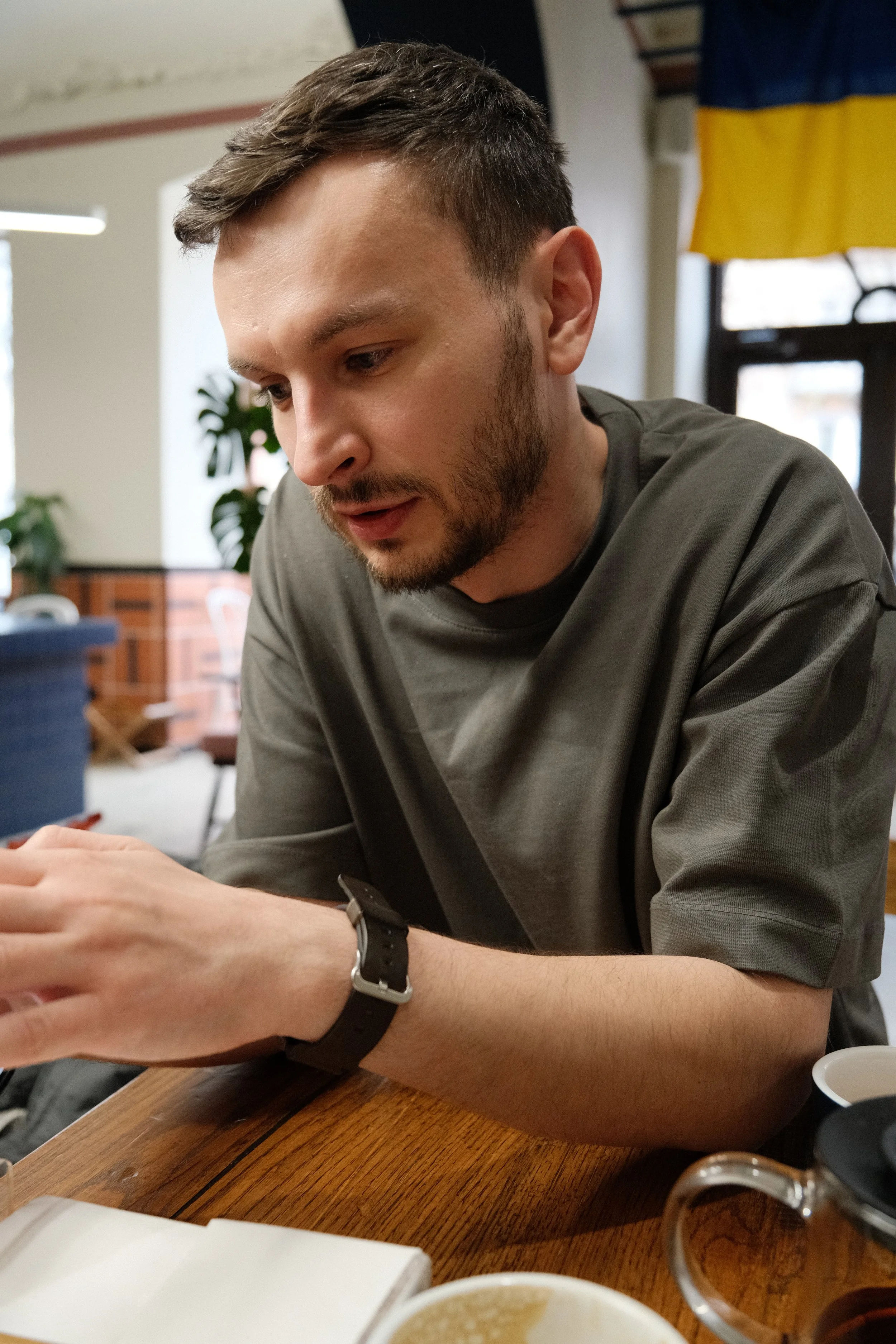
Стас — корінний одесит, чиє світосприйняття завжди було гострим і дещо пророчим. Він виріс у російськомовному середовищі, але задовго до 2022 року позбувся ілюзій щодо намірів сусідньої держави. Для нього повномасштабне вторгнення не стало сюрпризом — це була реальність, яку він прогнозував роками, спостерігаючи за тривожними маркерами в атмосфері міста ще з 2014-го.
До війни Стас успішно поєднував роботу в міжнародному маркетингу з активною громадською позицією. Його знали як захисника архітектурної спадщини Одеси та її узбережжя. Вечір 23 лютого він провів за переглядом фільму «Не дивіться вгору», але думками був у стрічці новин. Ранок наступного дня, що почався з вибухів, лише підтвердив його найгірші очікування.
Після організації евакуації родини до Львова та короткого перебування там, Стас відчув непереборне бажання повернутися. Його шлях до спротиву почався з ролі перекладача для іноземних добровольців Міжнародного легіону. Він допомагав тим, хто приїхав воювати за Україну, налагоджувати комунікацію та проходити навчання.
У 2023 році професійний шлях Стаса зробив новий виток — він приєднався до структури ООН як фахівець із комунікацій. Робота перетворилася на безперервні поїздки прифронтовими регіонами, де він документував гуманітарні катастрофи та зусилля з їх подолання.
«Фотографія під час війни — це постійне запитання до самого себе: чи достатньо просто фіксувати? Чи має цей кадр вагу, коли поруч триває трагедія?»
Відповідь прийшла у вигляді визнання: його роботи використовувала Саманта Пауер, представляючи позицію США в ООН. Це підкреслило масштаб і важливість його внеску в інформаційну оборону країни.
Як фотограф, Стас гостро відчуває, як змінилася дистанція між камерою та містом.
Тепер людина з фотоапаратом викликає не цікавість, а запитання. Суспільство стало більш настороженим.Осибливо гостро це було на початку березня 2022 року.
Стас свідомо відійшов від прямої фіксації руйнувань, зосередившись на архітектурі, абстрактних формах та аналоговій плівці.
Його кадри стали стриманішими. Серія «Waiting War», створена ще у 2021-му, сьогодні виглядає як монохромний пролог до великої трагедії.
Навіть море змініло свій зміст. Колись символ свободи та відпочинку, тепер воно сприймається як джерело небезпеки, звідки приходять ворожі дрони. Одеса для нього — це місто, де уламки вибитого скла можуть тижнями лежати на асфальті, нагадуючи про крихкість буття.
Попри війну, Стас залишається залученим у внутрішні зміни міста. Його надихають протести молоді проти корупції (зокрема події липня 2025-го) та структурні зміни в управлінні містом. Усунення багаторічного мера та демонтаж імперських пам’ятників він сприймає як шанс для Одеси нарешті переосмислити свою ідентичність.
«Відсутність старих ідолів породжує головне питання: що має посісти їхнє місце? Які наративи ми оберемо для майбутньої Одеси?»
Сьогодні Стас перебуває на порозі сорокаріччя. Разом із дружиною вони замислюються про створення сім’ї — рішення, яке пандемія та війна змушували відкладати. Це тихий, але важливий акт віри в майбутнє, яке він продовжує фіксувати через свій об’єктив.