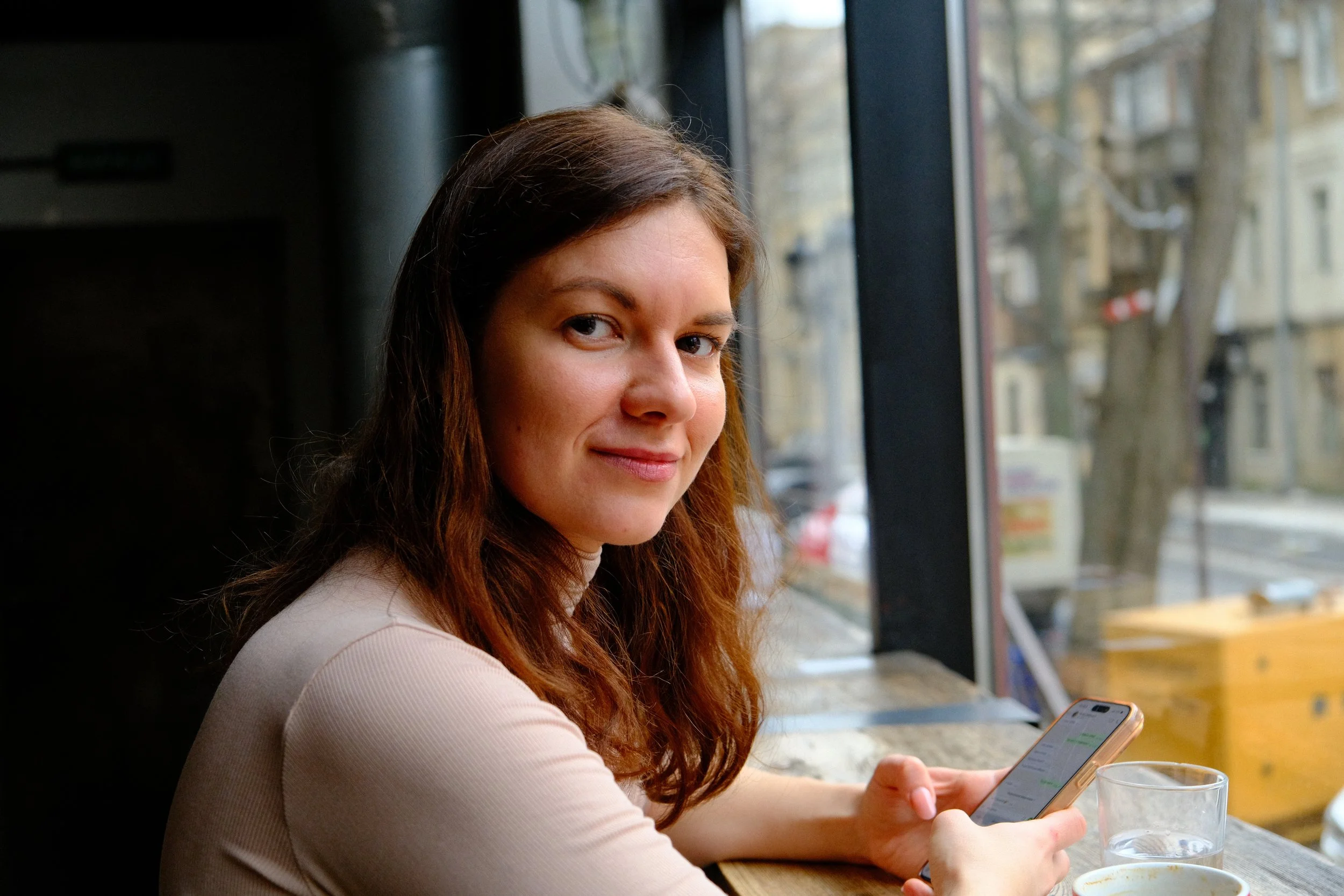
Viktoriia, works for a humanitarian organisation
Viktoriia is originally from Khmelnytskyi. She moved to Odesa in 2011, where she began an independent life and gradually made the city her home. By the time the war began, Odesa was no longer a place she had moved to—it was where she belonged.
On 23 February 2022, the day before Russia launched its full-scale invasion, Viktoriia was working with the Ukrainian Red Cross. That day, she met an Afghan refugee who told her plainly: “If the war between Ukraine and Russia starts tomorrow, I will leave. I will run.” The words stayed with her. Although she had been preparing mentally for the possibility of war, she had not believed it could begin so abruptly. Like many others, she had a contingency plan—but not the certainty that it would be needed immediately.
Early in the morning of 24 February, a friend called to say that the war had started. Soon after, Viktoriia heard explosions in Odesa. Around 11 a.m., she saw smoke and fire. What would happen next—tomorrow, the next day—was impossible to imagine. Later that afternoon, she went into the city. Cash machines were empty. At the same time, she saw mothers sitting with their children, playing quietly in the sun. For a moment, it felt unreal, as if the war might still be a bad dream.
She considered leaving the country but decided to stay. She was afraid of a potential blockade of Odesa, yet what she saw at the Red Cross that day changed her decision. People arrived in large numbers, offering help—cars, food, time, labour. The spontaneous wave of solidarity and civic responsibility convinced her that she wanted to remain. “If you’re doing something for your country,” she says, “you feel happier. It gives meaning to what you’re living through.”
Many of her friends left Ukraine in the first months of the war. Sometimes, Viktoriia feels conflicted when she speaks with them. They talk about the hardships of refugee life in Western Europe, while she has stayed in a country under attack. Her mother and her youngest brother left Odesa in March 2024 and now live in Warsaw. Her mother regularly urges her to move as well. Viktoriia refuses. Odesa, despite everything, is where she has chosen to live.
She no longer goes to shelters regularly. The situation has become familiar, even if it remains dangerous. At the same time, she has adapted her own rules. When she is at the beach and an air-raid alarm sounds, she goes to shelter. She jokes about it, but the calculation is serious: survival has become part of everyday decision-making.
The war has also reshaped her relationship to language and identity. When Viktoriia first moved to Odesa, she had to learn Russian and spoke it daily until 2022. Since the beginning of the full-scale war, she has switched entirely to Ukrainian. She notices the change around her as well. More people speak Ukrainian. More wear traditional embroidered shirts. Ukrainian music is heard more often in public spaces. Christmas carols are now sung on 25 December.
Odesa itself has changed. More than 160,000 internally displaced people have arrived, while many long-term residents have left. The city feels different—less carefree, less playful. Viktoriia avoids the nightlife in Arcadia. She finds it unsettling to party while the war continues.
As a young woman, she thinks about relationships, family, and the future—but all of it feels postponed. She does not want to date someone avoiding mobilisation, yet she is afraid to build a relationship with a soldier, knowing how constant fear could shape daily life. At one point, she considered joining the military herself. Instead, in late 2022, she began working full-time with a humanitarian organisation, where she remains actively involved. She knows she might one day choose a different path—but for now, this work anchors her.